
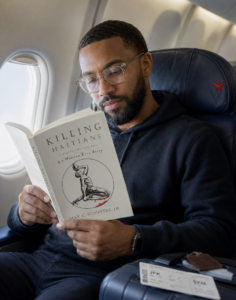
Some books help pass the time during a long flight. Others make the airport announcements, rolling suitcase wheels, and quiet conversations around you disappear completely. Killing Haitians: A Mission Through Hell & A Haitian Love Story belongs to the second group.
Written by Max C. Sconyers Jr., the book recounts a thirty-day journey through Haiti that became far more dangerous than an ordinary trip abroad. Sconyers describes being held at gunpoint, kidnapped, injured, rescued, and confronted with violence that continued to affect him after he returned home. The result is a firsthand account of survival, human connection, personal failure, fear, and the lasting consequences of entering a place without fully understanding what may be waiting there.
For travelers who enjoy memoirs, international stories, real-life suspense, and books that reveal more than a polished version of a destination, Killing Haitians offers an intense reading experience. It is not a cheerful guidebook filled with restaurant recommendations and postcard photographs. It is a raw account of what can happen when a journey leaves the expected path and becomes a struggle to stay alive. 📖✈️
A Travel Story That Refuses to Feel Predictable
Many travel books follow a comfortable rhythm. The writer arrives in an unfamiliar place, experiences a little culture shock, meets interesting people, eats unfamiliar food, and returns home with a collection of amusing memories. Killing Haitians moves in a different direction.
The tension comes from knowing that the events were not designed by a novelist. Sconyers was not a fictional hero protected by a carefully planned ending. He was a traveler whose circumstances could change in a matter of seconds. A wrong decision, a misunderstanding, or an encounter with the wrong person could produce consequences that could not be reversed.
That uncertainty gives the book its urgency. The danger does not feel like a dramatic decoration added to make the story more exciting. It feels unstable, personal, and close. The reader understands that survival may depend on choices made under pressure, the actions of strangers, and moments of compassion that arrive when they are least expected.
Readers searching for True survival stories in Haiti will find more than a sequence of frightening incidents. They will find an account shaped by vulnerability, imperfect judgment, emotional turmoil, and the realization that a person can lose control of a situation much faster than expected.
Haiti Is More Than a Background for the Story
Haiti is often discussed through brief headlines about political unrest, natural disasters, poverty, humanitarian emergencies, and violence. Those subjects are part of the country’s modern history, but they do not represent the whole of Haiti or the lives of its people.
The nation occupies the western portion of Hispaniola, an island it shares with the Dominican Republic. Its history includes revolution, independence, foreign intervention, cultural achievement, political upheaval, and generations of resilience. Readers who want broader historical and geographic context can explore Wikipedia’s overview of Haiti before or after reading the book.
In Killing Haitians, Haiti is not presented as an empty stage where one visiting American experiences danger. The story includes Haitian individuals, families, relationships, acts of courage, suffering, kindness, and contradiction. The country contains people capable of violence, people willing to help, and people simply trying to survive circumstances that outsiders may never completely understand.
That human complexity matters. A weaker survival story would reduce an entire nation to a frightening setting. Sconyers’ account carries greater weight because the journey includes affection and connection alongside fear and brutality. The subtitle, A Mission Through Hell & A Haitian Love Story, reflects that tension. Darkness and tenderness exist within the same narrative.
The Firsthand Perspective Gives the Book Its Power
News reports can summarize a kidnapping in a few sentences. Statistics can record crime, unrest, injuries, and deaths. Neither can fully communicate the feeling of standing near a weapon, losing control of one’s movement, or waiting without knowing what another person plans to do.
Firsthand writing closes some of that distance. It allows readers to experience the confusion before the danger becomes obvious. It captures the physical reactions, rushed decisions, misplaced confidence, and details that may appear insignificant until the situation becomes threatening.
Sconyers does not present himself as an untouchable adventurer who handled every crisis perfectly. His account is more uncomfortable than that. He entered Haiti while already dealing with internal turmoil, and his state of mind traveled with him. His weaknesses, intentions, decisions, and relationships all became part of what happened.
That honesty strengthens the book. Perfect heroes often feel distant because most readers know they would not behave perfectly in a crisis. A flawed narrator creates a different kind of connection. Readers can recognize how confusion, stress, pride, fear, or desperation might influence their own decisions.
The story also shows that physical survival does not always create an immediate emotional ending. A person may escape danger while continuing to carry guilt, grief, anger, fear, and unwanted memories. The body returns home, but the mind may remain attached to what happened.
A Compelling Book for Long Flights and Unfamiliar Places
Travel creates a rare kind of reading time. A passenger may spend several uninterrupted hours on a plane, train, cruise ship, or bus. Hotel evenings can also become quiet stretches of time without the usual responsibilities waiting at home.
Killing Haitians fits those moments because it develops momentum quickly. The reader is not simply observing a distant event. The story creates the sensation of moving through an unstable environment where safety can disappear without warning. That tension makes it easy to continue from one chapter to the next.
Reading it during a trip also gives the story an added layer of meaning. Airports, passports, hotel rooms, foreign roads, and unfamiliar faces stop feeling like ordinary pieces of a vacation. They become reminders that travel always contains an element of uncertainty, even when a journey has been carefully planned.
Responsible travel begins long before boarding. International travelers can review identification, visa, passport, and health requirements through the IATA Travel Centre. Air passengers can also use the Transportation Security Administration’s travel tips to prepare for airport screening, baggage restrictions, identification requirements, and other parts of the departure process.
Those resources deal with the practical side of travel. Killing Haitians explores something a checklist cannot fully address: the emotional reality of losing control in an unfamiliar country.
The Book Encourages Travelers to Take Preparation Seriously
A gripping survival memoir can entertain readers while still leaving them with practical lessons. One of the clearest lessons in Killing Haitians is that good intentions do not guarantee safety. Enthusiasm, confidence, charitable motives, religious purpose, or curiosity cannot replace preparation.
Conditions can change, especially in destinations affected by unrest, limited infrastructure, crime, severe weather, health emergencies, or political instability. Travelers should rely on current information rather than memories, assumptions, social media posts, or outdated travel articles.
The U.S. Department of State’s Haiti Travel Advisory should be reviewed by American citizens considering travel to the country. As of July 10, 2026, the department maintained Haiti at Level 4, advising Americans not to travel because of risks that include kidnapping, crime, terrorism, unrest, and limited health care.
Health planning is equally important. The CDC’s Haiti Traveler View provides destination-specific information concerning vaccines, medicines, disease prevention, food and water precautions, insect protection, and medical preparation. The CDC currently recommends that travelers to Haiti discuss prescription medicine for malaria prevention with a medical professional.
Travelers returning to the United States can also consult U.S. Customs and Border Protection’s Know Before You Go guide for information about documents, declarations, prohibited items, and returning with purchases from abroad.
These links are not included to turn a book review into a warning manual. They reinforce one of the memoir’s lasting ideas: international travel deserves humility. Preparation cannot eliminate every danger, but it can prevent avoidable mistakes and help travelers make decisions based on reliable information.
The Story Connects Personal Survival With Global Travel Awareness
Modern travel is influenced by more than airline schedules and hotel prices. Political developments, public health conditions, border policies, natural disasters, security concerns, and economic changes can reshape tourism quickly.
Readers who follow international travel developments can find broader industry reporting through UN Tourism’s news center. Its coverage offers insight into global tourism patterns, destination development, policy changes, sustainability, and the events influencing how people move across borders.
That wider perspective makes a memoir like Killing Haitians especially relevant. Travel is often marketed as effortless freedom. Advertisements show empty beaches, smiling residents, luxury accommodations, and simple adventures. Those images may be real, but they represent only one part of international movement.
Every destination has layers that visitors may never see. Local residents experience political, economic, cultural, and social realities that tourists can easily overlook. A traveler may arrive with money, mobility, and the expectation of returning home, while the people encountered along the way remain inside the conditions the visitor briefly witnessed.
Sconyers’ experience removes the protective distance that travelers often feel. He enters situations where the usual advantages of being a visitor cannot guarantee his safety. The journey forces him to depend on other people and confront realities that cannot be reduced to a vacation photograph.
More Than a Story About Escaping Physical Danger
The most memorable survival books do more than describe how someone escaped. They examine what the experience revealed about the survivor.
Killing Haitians gains depth from the conflict between external danger and internal struggle. The violence and kidnapping create immediate suspense, but the emotional and spiritual consequences give the story its staying power. Survival becomes more than reaching a safe location. It includes the difficult process of understanding what happened and deciding how to live with it.
The book also explores the complicated role of human connection. Rescue rarely occurs in isolation. Someone must notice, intervene, take a risk, offer information, provide shelter, or choose compassion. In dangerous situations, another person’s decision may become the dividing line between life and death.
This human element prevents the story from becoming a simple collection of shocking scenes. The account includes fear, but it also includes affection. It contains violence, but it also contains help. It records terrible losses while recognizing the people whose actions made survival possible.
That balance is difficult to achieve. Too much emphasis on danger can make suffering feel sensationalized. Too little detail can weaken the emotional truth. Sconyers’ story remains compelling because the events are connected to their personal cost.
A Travel Read That Stays With You After the Trip
The best travel books continue working on the reader after the suitcase has been unpacked. They change the way a person thinks about borders, strangers, risk, privilege, preparation, and the meaning of home.
Killing Haitians may cause readers to approach future trips with greater awareness. It encourages respect for local conditions, careful research, attention to official guidance, and a willingness to recognize that visitors rarely understand a country as completely as its residents do.
At the same time, the book provides the momentum readers expect from a thriller. There are weapons, uncertainty, injury, captivity, rescue, and consequences. The difference is that these events belong to a firsthand account rather than an invented plot.
That combination makes the book well suited for travelers who want something more substantial than a light airport novel. It offers suspense without separating danger from its emotional cost. It introduces readers to a complicated journey without pretending that one person’s experience defines an entire nation. It also leaves room for faith, love, regret, compassion, and personal reckoning. 🌍
Conclusion
Why Killing Haitians Is One of the Most Gripping True Survival Stories in Haiti—and the Travel Book You Won’t Be Able to Put Down is more than an attention-grabbing description. It reflects what makes Max C. Sconyers Jr.’s account so difficult to set aside.
The book places readers inside a thirty-day journey marked by gunpoint encounters, kidnapping, injury, violence, rescue, and unexpected human connection. It also looks beyond those events to consider what survival does to the mind, the spirit, and the way a person understands the world afterward.
For readers drawn to international memoirs, real-life thrillers, Christian social themes, dangerous journeys, and stories of imperfect people facing extreme circumstances, Killing Haitians: A Mission Through Hell & A Haitian Love Story offers an unforgettable experience.
It is the kind of book that can fill the hours of a long flight while making the reader more aware of what travel truly involves. By the final page, Haiti no longer feels like a distant name on a map, danger no longer feels like an abstract headline, and survival no longer seems as simple as making it home alive.